Pagine

Visualizzazione post con etichetta Turkey. Mostra tutti i post

domenica 7 settembre 2014

Turkey: 82 refugees rescued after two days stranded at sea

ANSAmed
Istanbul - Eighty-two illegal refugees who human traffickers had promised to transport to Romania have been rescued after being marooned on a small boat 24 miles off the coast of Istanbul, as Dogan News Agency reported. The group of 82, composed of Afghans, Syrians, and Iranians, included 15 children and 20 women, two of whom were pregnant. They had been left at sea after the captain promised to bring help to fix to a technical problem but never returned.
The capacity of the 15-meter boat was 50 people, according to news reports. After two days without food or water, the refugees started a fire on the ship to attract attention. A ship en route from the Black Sea to the Bosphorus Strait noticed the fire and informed coastguards, who reached the boat at around 10:30 on September 4. The refugees were taken to a pier at Cayirbasi and were offered food, water and medical help. The police are still searching for the captain who marooned the migrants.

The number of illegal migrants trying to reach countries neighboring Turkey is increasing rapidly, mainly due to the unrest on the country's southern border. Migrants risking their lives while trying to enter Greece illegally also come from African and Asian countries. The coast guards have captured 7,540 illegal migrants trying to reach Greece via the Aegean Sea this year, according to data provided by the Izmir Governor's Office yesterday. 

The total number stood at 6,937 last year, a dramatic increase from just 2,531 in 2012. Amnesty International wrote in a June report that the policies of the European Union and its member states were putting at risk the lives and rights of refugees in many countries, including Turkey. Figures indicate that the Aegean Sea has turned into "sea of illegal migrants." (ANSAmed).

mercoledì 19 giugno 2013

U.N. human rights official calls for change in Turkish police tactics

UPI
ISTANBUL, Turkey- A U.N. human rights official said Tuesday the situation in Turkey, where development in a park was a flashpoint for wider unrest, remains "highly combustible."

Navi Pillay, the United Nations high commissioner for human rights, called on the government to curb police abuses and heavy-handed tactics.

"The atmosphere is still clearly highly combustible," she said. "It is important that the authorities recognize that the initial extremely heavy-handed response to the protests, which resulted in many injuries, is still a major part of the problem."

As Pillay issued her statement, the government continued to search for organizers of the 22-day Taksim Square protests, conducting raids in Ankara and Istanbul. Nearly 200 people were detained in Istanbul where authorities charged 22 of them with organizing violent protests, Turkey's Hurriyet Daily News reported.

In addition to individuals, police raided Atilim Newspaper and Etkin News Agency in Istanbul.

Human Rights Watch said it has documented arbitrary detentions last weekend.

"The police assault on a peaceful crowd in Gezi Park and teargas use in confined spaces showed a dangerous disregard for the well-being -- and indeed the lives -- of protesters and bystanders," said Emma Sinclair-Webb, a senior Turkey researcher. "The repeated police violence against people who are dissatisfied with government policies has deeply polarized Turkey. The government urgently needs to change police tactics and issue a clear signal for restraint."

Turkey's government set off nationwide protests following a crackdown on environmentalists and other activists opposed to plans to cut down trees and redevelop a park adjacent to Istanbul's Taksim Square, Today's Zaman reported.

A Turkish man who stood silently in the square for 6 hours Monday night was identified as performance artist Erdem Gunduz. He was joined by hundreds of people eventually dispersed by police for blocking traffic.

Turkish Prime Minister Recep Tayyip Erdogan, who has held power for 10 years, mobilized supporters for two huge weekend rallies.

He has criticized media coverage of the protests and lashed out at unspecified foreigners who he said want to hurt Turkey.

giovedì 13 giugno 2013

Amnesty International, Human Rights Watch condemn Turkey's crackdown on protesters

Tehran Times
Amnesty International and Human Rights Watch on Tuesday condemned the Turkish police for using brutal force against anti-government protesters.
Violent clashes between the police and the protesters continued throughout Tuesday, and both sides took and lost control of Istanbul's Taksim Square several times.

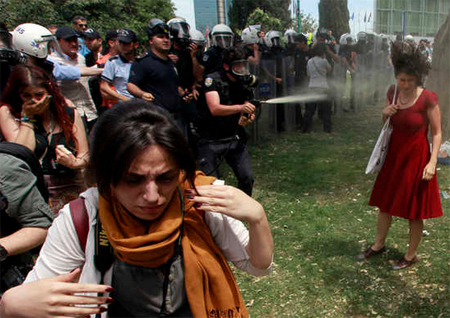
On Tuesday night, thousands of protesters returned to the square. Special police forces used tear gas, rubber bullets, and water cannons to disperse the demonstrators.

Turkish riot police fought running battles with pockets of protesters Tuesday night, clearing the central Istanbul square that has been the focus of nearly two weeks of protests against Prime Minister Recep Tayyip Erdogan.

By Wednesday morning, Taksim Square, strewn with wreckage from bulldozed barricades, was largely deserted and taxis crossed it for the first time since the troubles started. Several hundred remained in an encampment of tents in Gezi Park abutting the square.

Andrew Gardner, Turkey researcher at the London-based Amnesty International, in a statement censured Turkey for the recent acts of police brutality.

“Instead of continuing to repress peaceful activists, the Turkish authorities should start to look at the actions of their own police and bring to justice those responsible for the shocking abuse we have seen over the past two weeks,” he said.

“The protests in Taksim Square and Gezi Park have been entirely peaceful and have a right to continue,” added Gardner, who is currently in Istanbul.

Human Rights Watch issued a statement, saying Tuesday's police attack on “tens of thousands of peaceful protesters has all but destroyed efforts to foster a peaceful dialogue between the government and protesters.”

“Tear-gassing tens of thousands of protesters in Taksim Square won't end this crisis,” said Emma Sinclair-Webb, Turkey researcher at the New York-based Human Rights Watch.

“If Turkey is to be counted among rights-respecting countries, the police brutality has to stop and the government should talk to the protesters.”

Also on Tuesday, in a televised speech to parliament, Erdogan said the government would not show “any more tolerance” for the violent demonstrations.

“They say the prime minister is rough. So what was going to happen? Were we going to kneel down in front of these [people]? If you call this roughness, I'm sorry, but this Tayyip Erdogan won't change,” he declared.

“To those who… are at Taksim and elsewhere taking part in the demonstrations with sincere feelings: I call on you to leave those places and to end these incidents and I send you my love. But for those who want to continue with the incidents I say: 'It's over.' As of now we have no tolerance for them,” Erdogan stated.

“Not only will we end the actions, we will be at the necks of the provocateurs and terrorists and no one will get away with it,” he added.

The unrest began on May 31 after police broke up a sit-in held at Istanbul's Taksim Square to protest against the proposal to demolish Gezi Park.

Over the next 12 days, tens of thousands of anti-government protesters held demonstrations in 78 cities across the country.

According to the Turkish Human Rights Foundation, four people have died, including a policeman, and about 5,000 people have been injured in the protests.

The protesters say Gezi Park, which is a traditional gathering point for rallies and demonstrations as well as a popular tourist destination, is Istanbul's last green public space.

Erdogan has been harshly criticized for the way he has handled the crisis.

According to a number of political analysts, the popularity of the ruling AK Party -- which has won three straight elections -- could decline if Erdogan does not resolve the crisis in a way acceptable to the general public.

lunedì 10 giugno 2013

European Union foreign policy chief Catherine Ashton warns Turkey on human rights

The Sofia Globe
European Union foreign policy chief Catherine Ashton has issued a reminder to Turkey that the country’s EU accession negotiations “provide the framework for ensuring full commitment to and guarantee of human rights”.

Ashton issued the warning on June 9, while the following day – the 11th straight day of demonstrations – protesters again clashed with police in capital city Ankara.

On June 9, Turkish prime minister Recep Tayyip Erdogan said that he had “limited patience” with the protesters. Erdogan said that marchers would “pay a price,” adding that he would have to “speak the language” they understand, the Voice of America reported.

In her statement, Ashton said that she continued to be concerned by the situation in Turkey and was following developments very closely.

“I am deeply saddened by the deaths and many injuries that have occurred, and I send my sympathies and condolences to all those who have been hurt or bereaved. It is essential that all violence stops and that all cases of excessive use of force by the police are recognised as such and investigated promptly, and that those responsible are held fully accountable,” Ashton said.

The continuing tensions underline the need for restraint on all sides and the importance of finding a quick solution based on dialogue, mutual respect, understanding and inclusiveness. Open and sustained engagement of the authorities is essential to reinforcing democracy, building confidence and avoiding escalation, she said.

Turkey’s EU accession negotiations and commitment to the Copenhagen criteria provide the framework for ensuring full commitment to and guarantee of human rights and fundamental freedoms for the benefit of all citizens of the country, without discrimination.

These include freedom of expression, freedom of assembly, freedom of religion, belief and thought and freedom of the media, including the responsibility to exercise it actively.

“Social media must not come under arbitrary pressure. Any limitations should be strictly within the limits defined by the ECHR and the jurisprudence of the ECtHR,” Ashton said.

She said that the EU was fully committed to reinforcing dialogue with Turkey on these important issues and so to making further progress within Turkey’s EU accession process.

On June 9, Erdogan urged his supporters to avoid violence and use local elections next year to “teach a lesson” to their opponents.

Three people have been killed and thousands hurt since the protests began against government plans to tear down a public park in Istanbul. They have since turned into protests against what marchers call the prime minister’s imposition of his Islamist views on a secular nation.

lunedì 3 giugno 2013

Turkey: End Police Violence at Protests

Human Right Wath

Prime Minister Recep Tayyip Erdoğan’s government should end police violence and excessive use of force against protests across Turkey. Officials should uphold the right to peaceful protest and free speech.

Police violently dispersed peaceful protests against government plans to transform Istanbul’s Taksim Gezi park into a shopping mall, triggering wider public protests across Istanbul that spread to Ankara and other cities.

[...] 
The protests are continuing amid signs that what began as an environmental movement against an urban regeneration project has become a wider expression of discontent with government policies by people across the political spectrum. There has been little live coverage of the events on Turkish television channels, though there has been coverage, including many photographs, on news websites and social media.

The Istanbul governor’s office reported on May 31 that only 12 people had sustained serious injuries and 63 had been detained by police. But information from eyewitnesses about the force used by police and the number of protesters involved suggests that the number of injured is likely to be very much higher.

Human Rights Watch interviewed political commentator and academic Ahmet Insel, who reported seeing ambulances repeatedly ferrying people to the Taksim İlk Yardım Hospital on May 31, 2013. Ahmet Insel told Human Rights Watch that he visited the Alman Hastanesi (German Hospital), where a 23-year-old student from Istanbul Technical University had been admitted, said by doctors to have lost his eye after being shot at close range by the police. A doctor told Insel that hospital staff had removed a plastic bullet from the student’s eye.

Journalist Ahmet Şık told Human Rights Watch that when he tried to visit Taksim Gezi Park with a delegation from the opposition Peoples’ Republican Party (CHP), including members of parliament, police threw a gas capsule at his head at close range. He sustained trauma to his head, which was bleeding profusely, and was taken immediately to a hospital.

“The Turkish authorities should urgently review policing policies and hold to account police chiefs whose units attacked peaceful protesters,” Sinclair-Webb said. “The government should also examine police use of tear gas, which poses a significant health risk and can be lethal.”

Erdoğan stated on June 1 that the government would go ahead with plans to transform Taksim Gezi park. He condemned the protests as a “game” and although he admitted mistakes in the use of tear gas by the police, he indicated there would be no retreat, asserting, “the police were there yesterday, and police will be there today and tomorrow.” By the afternoon of June 1, after repeated use of tear gas to disperse thousands of demonstrators massing in the main streets leading to Taksim square and Gezi park, the police began to withdraw from Taksim square and thousands of people moved into the square and park.

Human Rights Watch has noted Turkey’s restrictions on free speech and politicians’ intolerance of dissenting voices, and criticized Turkish police’s routine ill-treatment of demonstrators, and the failure to hold to account officers who use excessive force.

Protests against the demolition of part of Taksim Gezi Park to widen a street began at night on May 27, when a campaigner staged a non-violent sit-in to stop the works. The demolition is connected to a major tunnel-construction project that will route traffic to run under the square. Protesters believed the demolition was the first step in a government project to transform the tree-lined park, one of the city’s few green spaces, into a shopping mall. The project is controversial, because the prime minister imposed the scheme without public consultation, despite significant opposition.

On the afternoon of May 28, after the demolition had restarted under police protection, Istanbul Peace and Democracy Party (BDP) member of parliament Sırrı Süreyya Önder stood before the bulldozers to stop it. He protested that this leg of the project had not been authorized and was unlawful. Önder’s action temporarily brought the demolition works to a halt again. Campaigners then staged a peaceful sit-in in the park, refusing to leave.

At around 5 a.m. on May 30, police raided the park and forcibly removed the campaigners, using tear gas. At least one man was injured. Quickly regrouping, campaigners continued their sit-in and the police conducted two raids on May 31. CHP member of parliament İlhan Cihaner was among those who suffered excessive exposure to tear gas that day.

Major conduits leading to Taksim were brought to a standstill on May 31, as police repeatedly repelled advancing groups of demonstrators. In the early evening, a Human Rights Watch researcher witnessed the events on Cumhuriyet Caddesi, a major avenue running alongside the park, from the upper floors of an office building. Few demonstrators on Cumhuriyet Caddesi used force, though a handful threw stones at the water cannon vehicles as they advanced. Police moved on the demonstrators, firing repeated rounds of tear gas canisters, sometimes at very close range. Small groups of protesters retreated down side streets and sheltered in buildings. This continued for hours, with demonstrators sometimes assembling to cheer, sing, shout slogans, beat drums, and beat on the iron barricades they had dismantled from the construction site.

CHP member of parliament Sezgin Tanrikulu was hospitalized after suffering a mild heart attack caused by exposure to tear gas on May 31. Önder was hit in the shoulder and foot by a tear gas capsule fired by the police.

On May 31, Istanbul governor Avni Mutlu blamed the protesters for spreading disinformation, and blamed provocateurs who had no interest in protecting the environment.

By contrast, the mayor of greater Istanbul, Kadir Topbaş, expressed remorse, saying officials had failed to tell campaigners that the demolition was for road works and not linked to the shopping mall project.